


Elizabeth Coit: An Early Champion of Affordable Housing
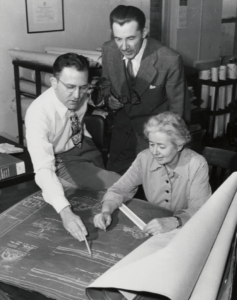 The movement to ensure safe, affordable housing for all Americans has been shaped by many dedicated advocates. Among them was Elizabeth Coit (1892–1987, sometimes spelled Elisabeth), an architect, planner, and housing reformer whose work helped bring national attention to the need for decent homes for low- and moderate-income families.
Although she worked largely behind the scenes, Coit played an important role in building the foundation for modern affordable housing policy and programs that continue to benefit communities today. The picture at right is Elizabeth Coit and NYCHA officials, circa 1950s. Elisabeth Coit Papers, Schlesinger Library, Harvard University.
Seeing Housing as a Public Good
Elizabeth Coit began her career as an architect during a period when many American cities were struggling with overcrowded and unsafe housing. In the early twentieth century, large numbers of working families lived in poorly constructed tenements with limited ventilation, sanitation, or access to green space.
Coit believed housing was more than just shelter. She saw it as a key factor in public health, family stability, and community well-being. This belief led her to focus not only on building design but also on housing policy and advocacy.
Building Support for Public Housing
In the 1930s and 1940s, Coit became a leading voice in the growing movement to address the nation’s housing shortage. She served as Executive Secretary of the Public Housing Conference, a national coalition of housing advocates, planners, labor leaders, and policymakers working to improve housing conditions for American families.
Through public education, research, and policy advocacy, the organization helped demonstrate that many families could not afford safe housing without government support. Coit worked tirelessly to build public understanding of the need for housing programs that served people with limited incomes.
Helping Shape National Housing Policy
The advocacy efforts of Coit and her colleagues helped influence major federal housing legislation. Among the most significant was the U.S. Housing Act of 1937, which created the country’s first permanent public housing program.
She also helped build support for the Housing Act of 1949, which established the national goal of providing “a decent home and a suitable living environment for every American family.” This landmark legislation helped expand federal investment in affordable housing and community development.
Lessons for Today
Elizabeth Coit believed strong communities depend on housing that is safe, stable, and accessible to people of all incomes. Her work reminds us that progress in housing often comes through collaboration between advocates, policymakers, and community organizations.
Today, Petra Community Housing continues the work that pioneers like Coit helped begin—developing affordable homes, supporting residents, and advocating for policies that expand housing opportunities.
By building on this legacy, we move closer to a future where everyone has access to a safe, affordable place to call home.